Mandatory Health Testing: Clinical Significance and Global Benefits
In the landscape of modern medicine, mandatory health testing stands as a bridge between individual well-being and public safety. While the term “mandatory” often sparks debate regarding personal autonomy, these protocols are typically established based on rigorous clinical evidence where the benefit of early detection significantly outweighs the risks of non-intervention.
Core Categories of Mandatory Testing
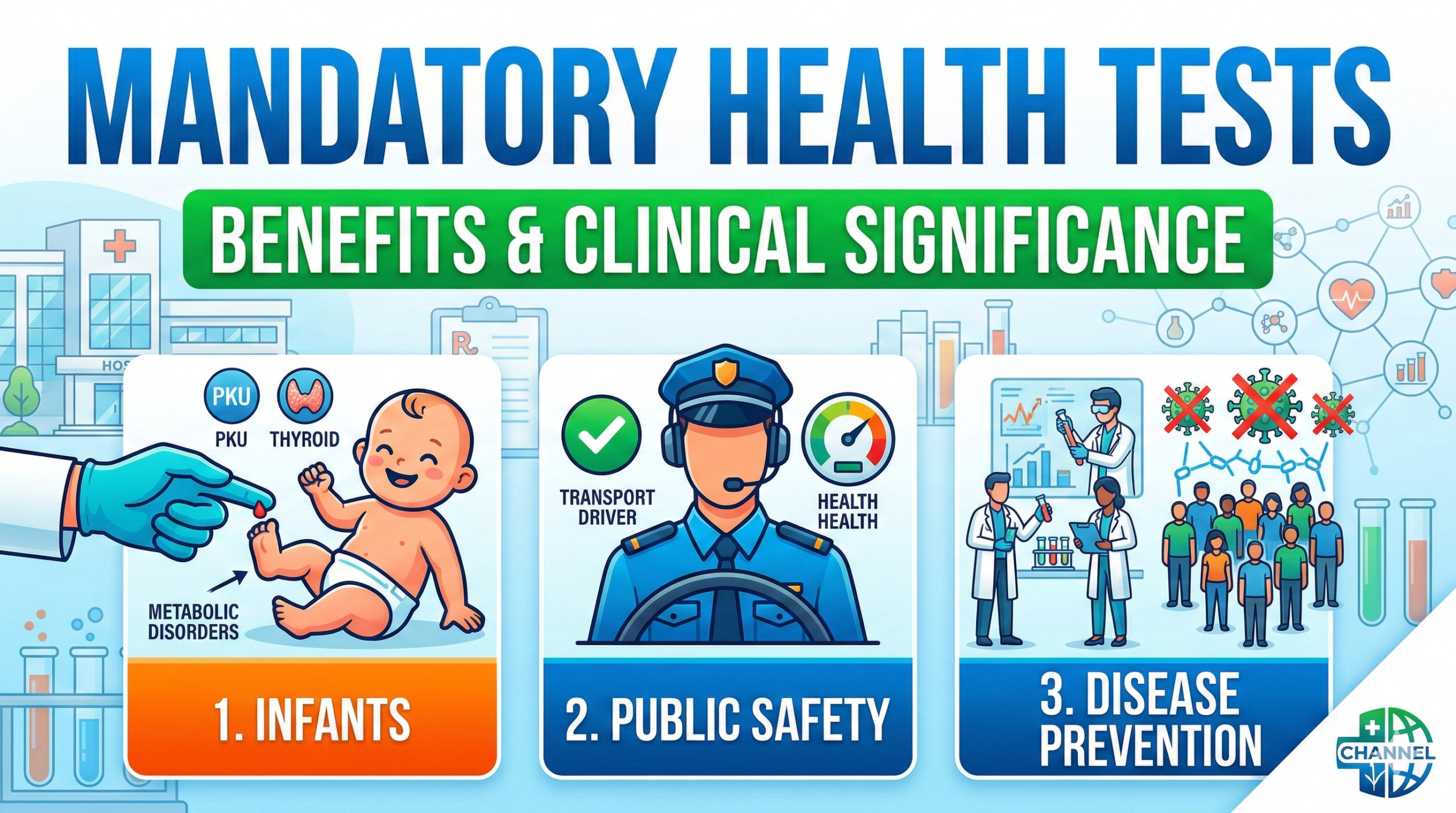
Mandatory health screenings generally fall into three primary categories, each serving a distinct clinical and social purpose.
1. Newborn Screening (NBS)
Performed within the first 24 to 48 hours of life, NBS is perhaps the most universally accepted form of mandatory testing.
-
Common Tests: Phenylketonuria (PKU), Congenital Hypothyroidism, Cystic Fibrosis, and Sickle Cell Disease.
-
Clinical Significance: These conditions are often asymptomatic at birth but can lead to irreversible neurological damage or death if left untreated.
-
Benefit: Early intervention (such as a specific diet for PKU) allows children who would otherwise face severe disabilities to lead normal, healthy lives.
2. Pre-Marital and Pre-Pregnancy Screening
In many regions, particularly where certain genetic traits are prevalent, testing before marriage is legally required or highly encouraged.
-
Common Tests: Thalassemia, Sickle Cell Trait, HIV, Hepatitis B/C, and Syphilis.
-
Clinical Significance: Identifies “carrier” status for recessive genetic disorders and detects infectious diseases that could be transmitted to a partner or offspring.
-
Benefit: Provides couples with informed reproductive choices and allows for medical management (like vaccinations or antiviral therapy) to prevent mother-to-child transmission.
3. Occupational and Public Safety Screening
Certain professions require “fitness-to-work” evaluations to ensure the safety of the employee and the public.
-
Examples: Vision and neurological tests for commercial drivers; infectious disease screening for healthcare workers; lung function tests for miners.
-
Clinical Significance: Detects underlying conditions that may impair performance or pose a contagion risk in high-density or high-risk environments.
-
Benefit: Reduces workplace accidents and prevents the institutional spread of diseases like Tuberculosis (TB).
The Clinical Significance: Why We Screen
The effectiveness of any mandatory test is measured by its clinical utility. For a test to be mandated, it must meet several criteria:
-
Treatability: The condition must have an available and effective treatment.
-
Latency: There must be a “window” where the disease is detectable but hasn’t yet caused irreversible harm.
-
Reliability: The test must have high sensitivity (to catch cases) and specificity (to avoid false alarms).
| Feature | Impact of Screening | Impact of No Screening |
| Disease Progression | Interrupted at the asymptomatic stage. | Often discovered only after permanent damage. |
| Treatment Cost | Lower; often involves management or prevention. | Higher; involves emergency care or long-term disability. |
| Public Health | Transmission chains are broken. | Outbreaks can occur in communities or workplaces. |
Broad Benefits to Society
-
Economic Efficiency: Preventing a disease is exponentially cheaper than treating its complications. Mandatory screenings reduce the long-term burden on national healthcare budgets and social security systems.
-
Health Equity: Mandating tests ensures that even vulnerable populations—who might not seek care due to lack of awareness or funds—receive a baseline level of diagnostic protection.
-
Data and Surveillance: Aggregated, de-identified results help health authorities track disease trends and allocate resources to the areas that need them most.
The Ethical Balance
The primary challenge of mandatory testing is the tension between beneficence (doing good for the population) and autonomy (the individual’s right to refuse). To remain ethical, these programs must be:
-
Proportionate: The severity of the health threat must justify the mandate.
-
Confidential: Results must be protected to prevent social or employment discrimination.
-
Evidence-Based: Protocols must be updated regularly to remove outdated tests and avoid “overdiagnosis”—detecting conditions that would never have caused harm.
Note: Mandatory health tests are not a substitute for a relationship with a primary care physician. They are “safety nets” designed to catch specific, high-impact conditions at a population level.
Follow Links
- Join Whats App Channel: Click Here
- Youtube Channel: Click Here
- Horror Stories: Click Here
- Entertainment: Click Here